HOPE WITH HARSHA - BECUASE EVERY POSSIBILITY BEGINS WITH HOPE !
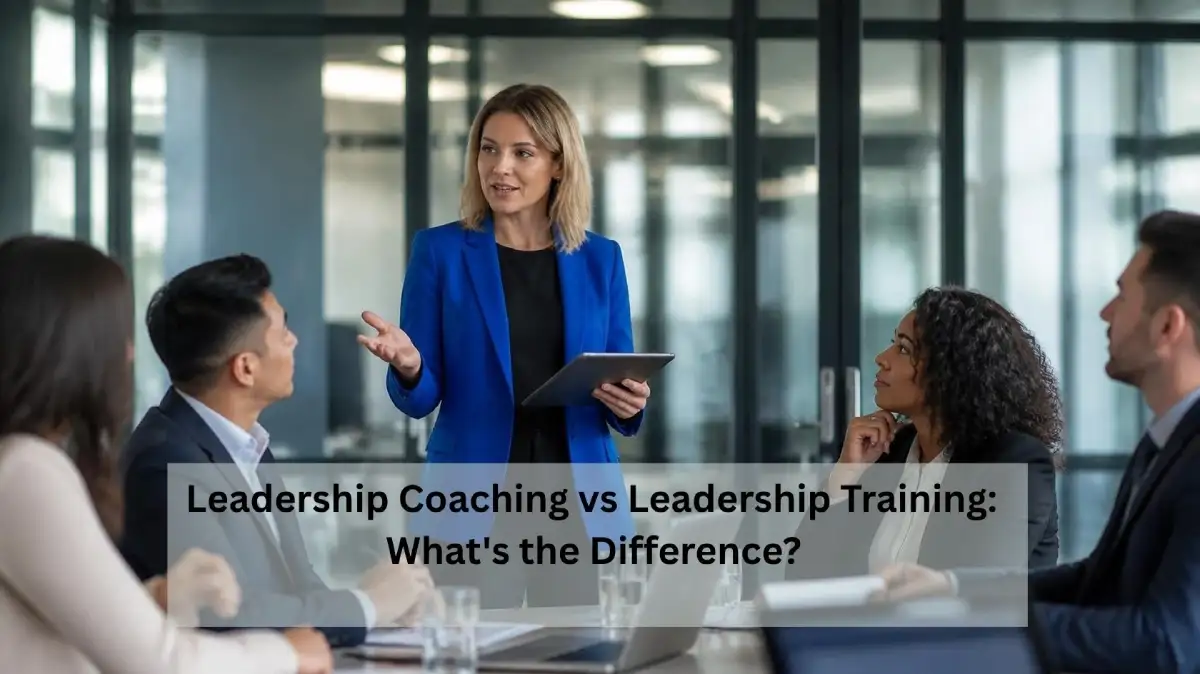
Leadership Coaching or Leadership Training, which is best? This question arises quite frequently when companies in Dubai want better managers, more cohesive teams, or leaders who can handle pressure without spreading it around.
The two things appear quite alike. Even so, they are completely different. Leadership training is basically about teaching. Leadership coaching is about guiding one to get through a problem. Although it looks like a small difference on paper, the gap between leadership coaching and leadership training becomes apparent in real-life situations.
A manager goes through a leadership training programme for two days and learns how to delegate, communicate, handle conflict, and manage emotions. On the return to work, she is full of zeal, which is a great opening. But then comes Monday. There’s a problematic employee and he is resisting. A big client is upset. An important date slips away. Now the PowerPoint slides look insufficient. It’s the point where coaching kicks in.
Training gives the map. Coaching deals with the road
Leadership training is generally structured around knowledge and skills. A group may learn how to conduct difficult conversations, give feedback, manage meetings, build trust, or make decisions.
For example, a Dubai-based company promoting five senior employees into management might organise a leadership training workshop. All five can learn the same framework. That makes sense.
But those five people are not facing the same problems. One manager may avoid confrontation. Another may control every small task. Someone else may struggle to speak confidently with senior executives. Another could be technically excellent but poor at listening. Training gives everyone a common foundation. Coaching gets more personal.
A leadership coach can explore why a particular leader keeps avoiding difficult conversations, what happens before that behaviour, and what could be changed next time. The conversation is less about memorising a model and more about understanding behaviour. That is often where real change becomes uncomfortable, but also useful.
What actually happens in leadership training?
Leadership training is normally planned in advance. There may be a syllabus, learning objectives, exercises, presentations, role plays and group discussions. Sometimes it happens for a few hours. Sometimes it runs across several days.
Common topics include communication, delegation, strategic thinking, team management, decision-making, conflict resolution and employee motivation. Imagine a newly promoted manager in a logistics company in Dubai.
The manager knows operations extremely well but has never managed people before. Training can explain the basics of one-to-one meetings, performance conversations and delegation. This is valuable because nobody automatically becomes a good leader just because a promotion letter says “Manager”. Still, training has a limitation. A trainer may explain what effective delegation looks like, but cannot spend every Tuesday afternoon watching how that manager delegates actual work. The classroom can create awareness. The workplace tests it.
Then what does leadership coaching do?
Coaching starts with the person rather than only the topic. A coach may ask questions such as: Why is this conversation being avoided? What does the leader expect will happen? What happened in the last similar situation? What would a stronger response look like?
There is no single perfect answer. That is important. A coach does not simply give another presentation about leadership. The leader examines real situations, choices, habits and reactions.
For example, consider a department head who keeps saying, “The team is not taking ownership.” Maybe the team really is weak. Or maybe the leader checks every decision, changes priorities repeatedly and corrects small mistakes publicly. In that situation, asking the team to “take ownership” will probably not solve much.
Coaching can help expose that gap. This is one reason leadership coaching can be especially useful for experienced leaders. At senior levels, the problem is not always lack of information. Sometimes the leader already knows exactly what should happen, but still behaves differently under pressure.
Dubai makes this conversation interesting
Dubai workplaces can be highly multicultural. A team might include people from India, the Philippines, the UK, Egypt, Pakistan, South Africa and many other places.
Communication styles can differ. A manager who thinks direct communication is efficient may be seen as rude by one employee. Another employee may prefer clear instructions and consider a softer approach confusing.
Leadership training can introduce cross-cultural communication principles. Useful, certainly. Coaching can then look at a real incident involving that leader and help them understand what actually happened. This distinction matters because leadership is rarely just theory.
A manager may know that active listening is important and still interrupt people during stressful meetings. Knowing the behaviour and changing the behaviour are two different jobs.
That is where organisations such as Hope with Harsha, led by Harsha Nair in Dubai, can position leadership development in a more practical way, especially for leaders who need reflection alongside skill development.
Leadership training is better when the problem is knowledge
There are situations where training is clearly the better option. If twenty new managers need to understand the company’s leadership expectations, a group programme is efficient.
If supervisors need to learn a new performance management process, training makes sense. If an organisation wants everyone to use the same communication framework, training provides consistency. It can also be easier to budget and organise.
Coaching becomes stronger when the problem is behaviour
Now consider a leader who has already attended three communication workshops. The leader knows about listening, knows about empathy and knows about feedback. Still, team members keep complaining that meetings feel intimidating.
Another workshop may not change much. Coaching could be more appropriate because the question has changed from “What should this leader know?” to “Why is this leader behaving this way?” That is a different problem.
Coaching is also useful when the situation is sensitive. A senior executive may not want to discuss insecurity, blind spots or relationship problems in a group classroom. A confidential coaching conversation gives more room for honesty.
Can leadership coaching and training work together?
Yes and honestly, that is often the most sensible approach. Training can create a shared language. Coaching can personalise the learning. Suppose an organisation runs a workshop on giving feedback. Managers learn a simple feedback framework. After the workshop, selected managers receive coaching while they apply it to real employee situations.
Now the learning does not remain inside the training room. A manager can bring a real conversation to the coaching session, discuss what happened, examine the response, and prepare differently for the next conversation. It becomes a cycle. Learn, Try, Reflect, Adjust & Try again. That is much closer to how leadership actually develops.
What should a company choose?
The answer depends on the problem, not the popularity of the service. Choose leadership training when a group needs common knowledge, new skills, shared processes or an introduction to leadership concepts.
Choose coaching when a leader needs individual attention, behavioural change, accountability, reflection or support during a difficult transition. Choose both when an organisation wants learning to move from theory into daily behaviour.
There is also a budget question. Training usually works better for reaching larger groups at once. Coaching generally requires more individual time, so it can make sense for senior leaders, high-potential employees, newly promoted managers or people handling particularly demanding roles. Still, price alone should not decide it.
A cheap training programme that changes nothing can be more expensive than a focused coaching engagement that prevents one talented manager from leaving. That sounds dramatic, but employee turnover, damaged trust and poor leadership decisions have real costs.
What makes a leadership programme useful in Dubai?
A useful programme should connect leadership ideas to actual workplace situations. For example, a manager may need to handle a multicultural team, communicate with a demanding regional director, manage hybrid employees and still deliver quarterly targets.
Generic advice like “communicate better” is not enough. The programme should explore what better communication means in that exact environment. For Dubai leaders, practical situations can include managing culturally diverse teams, handling fast business growth, moving into regional responsibilities, navigating hierarchy, and balancing directness with respect.
The best approach can also depend on seniority. A first-time manager may need substantial training. An experienced CEO may gain more from challenging conversations and coaching. A high-potential employee preparing for a bigger role may benefit from both.
The real question is not coaching or training
It is tempting to ask which one is better. That question is slightly misleading. The better question is: What does the leader need right now?
If the gap is knowledge, training can fill it. If the gap is application, coaching can help. If the gap is both, combine them.
Leadership is messy in real workplaces. People do not behave like case studies. A manager can understand a leadership model perfectly and still lose patience at 4:30 pm after six difficult meetings. That is normal. Development should account for that reality.
Leadership development is of interest to businesses and Hope with Harsha and Harsha Nair can serve when the emphasis is on practical aspects of leadership, self-reflection, and workplace behavior. The situation that calls for a workshop or a workshop-only approach is just another way of a business activity.
When you are looking for the difference between leadership coaching and leadership training, the way I described above makes it very clear for anyone to understand that training is mainly about building skills; whereas, coaching is about helping your skills translate into consistent behaviors. They are not to be seen as substitutes to each other at all. Sometimes a company needs to be taught. Sometimes an individual manager has to be shown what they are doing. Very regularly, a development path with the highest probability of resulting in an effective leader would have a combination of both methods.
FAQs
1. Is leadership coaching better than leadership training?
Neither is automatically better. Leadership training works well for teaching shared knowledge and practical skills to groups. Coaching is more suitable for personal behaviour, reflection and accountability. The right choice depends on whether the main gap involves knowledge, application, behaviour, or leadership transition.
2. How long does leadership coaching usually take?
There is no fixed duration. Some leaders need several focused sessions around one challenge, while others prefer coaching over several months. The useful measure is progress, not the number of sessions. Goals, leadership level, workplace pressure and complexity usually influence the timeframe.
3. Who should consider leadership coaching in Dubai?
Leadership coaching can support senior executives, newly promoted managers, business owners and high-potential professionals. It can be particularly useful when responsibilities increase, relationships become difficult, teams grow quickly, or a leader wants to understand personal habits that affect workplace performance and decisions.
4. Can companies combine coaching and leadership training?
Yes. Combining both can be highly practical. Training introduces frameworks and common leadership skills, while coaching helps individuals apply those ideas to real workplace situations. For example, managers can learn feedback techniques in training and then use coaching sessions to improve difficult conversations.