
HOPE WITH HARSHA - BECUASE EVERY POSSIBILITY BEGINS WITH HOPE !
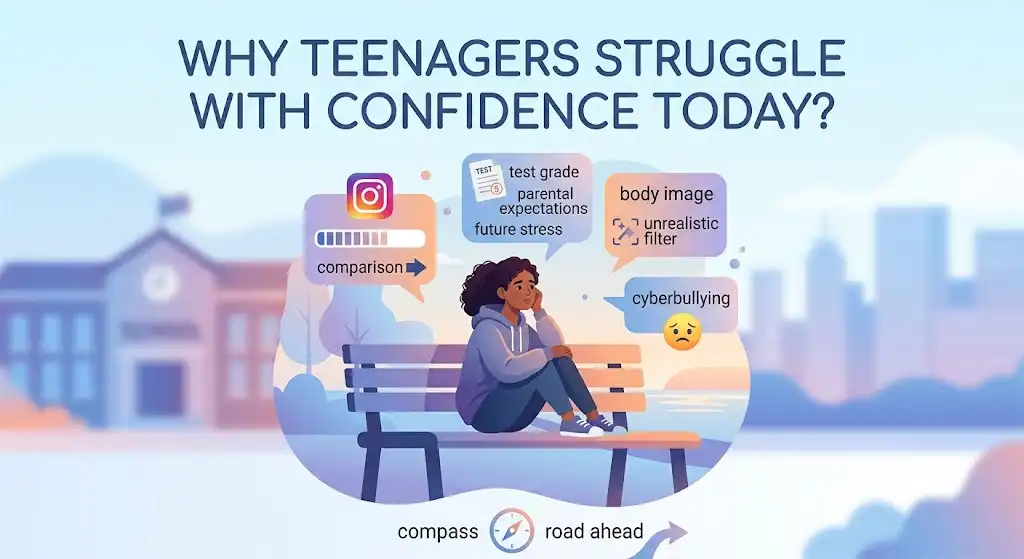
Why Teenagers Struggle with Confidence Today?
- On
- InBlog
At Hope With Harsha in Dubai there is a pattern that appears again and again. Teenagers who seem happy & comfortable on the outside also carry doubts inside. A young person may laugh with friends during the day & then spend hours at night worrying about looks, grades, friendships or the future. Confidence has become a real struggle for many teenagers today. In fact some of the most confident looking teenagers are often dealing with the biggest worries.
Life for teenagers feels crowded now. There is always something demanding attention. School assignments, messages, notifications, trends , opinions and expectations never seem to stop. A lot of young people barely get a chance to sit with their own thoughts. Everything moves fast. Maybe too fast sometimes.
In the past, teenagers mainly compared themselves with a few peers at school, neighbors or some friends. Comparison today is endless. With just a phone, a teenager can open it and instantly see hundreds of people who, at first sight, look more successful, more attractive, more talented or more popular than him. Their awareness that those images are to be carefully selected does the comparison back at the same time.
What makes confidence harder for teenagers today?
One of the primary reasons is giving constant visibility. Even if no one is observing, teens still feel like they are being watched. Social media has made it possible for ordinary moments to become public events in a way. While posting pictures, sharing thoughts, or posting videos may seem like a source of fun, at the same time it can be a source of stress.
Many teenagers spend a surprising amount of time thinking about reactions. Did people like the post? Did enough friends respond? Why did someone else get more attention? These questions seem small on their own. Repeated every day they slowly affect confidence.
Another challenge is the pressure to be good at everything. School performance matters. Sports matter. Appearance matters. Social life matters. Future plans matter. It may appear at times that teenagers are required to be successful in all aspects simultaneously. That is definitely a tough bar for anyone to reach.
Almost no allowance is given for errors. Yet, errors are actually the ways in which people learn. When you think that each failure counts, your self-esteem is very shaky. Just one poor mark, one clumsy instance or one unsatisfactory outcome can at once seem very exaggerated.
Why do social media platforms affect teenage confidence so much?
Social media tends to give people a carefully worded version of life. Teenagers get it. Most of them know that pictures are photoshopped and only the best moments are shown. The problem is that feelings don’t always follow logic.
A kid could be looking at pictures of holidays, parties , accomplishments and fake looking friendships. Even while being aware that those pictures are not the whole story, there can still be a feeling of running behind. It happens silently. Just a few minutes of scrolling can make one even start to doubt his/her life without even realizing the reason.
The pace of the online reaction is also a big factor. Likes, comments, shares and views come rapidly. Humans are hardwired to recognize approval & disapproval. Mainly Teenagers are very vulnerable to it as their sense of self is still maturing.
One harsh remark might haunt a teenager’s mind for a long time more than twenty good ones. A post which gets less attention than expected can very well make one’s mood suddenly drop. To adults, these moments are quite insignificant but to youth, they do Yes mean a lot.
Besides that, there is an urge to be up to date with the latest trends. Music changes at a rapid pace. So does fashion. Also, online chats are changing at a rapid speed. A few teenagers might be so concerned about the thought that missing a trend is the same as missing a chance to relate to others. The continual struggle may be quite tiring.
Are parents and teachers noticing the confidence problem?
Some adults recognize it immediately. Others miss it completely. Confidence struggles do not always look dramatic. A teenager may continue attending school getting decent grades and spending time with friends while quietly struggling with self doubt.
Parents often focus on achievements because they care about their children. They ask about grades, homework exams and future goals. Those conversations are important. At the same time teenagers also need conversations about feelings, worries and self belief.
When attention stays focused only on performance some young people begin connecting their value to results. They start believing they are worthy only when they succeed. That creates pressure that is difficult to carry.
Teachers face a different challenge. They spend time with many students every day. Some teenagers openly show insecurity. Others hide it very well. A quiet student may be struggling. A very outgoing student may be struggling too. Confidence issues can appear in different ways.
Sometimes a teenager stops participating in class because they fear being wrong. Sometimes they avoid activities because they fear judgment. Adults may see the behavior without seeing the reason behind it.
Can friendship struggles damage confidence?
Friendships have a huge influence during the teenage years. Feeling accepted matters deeply. Small changes in friendships can affect confidence more than many adults realize.
Being left out of a group conversation can feel painful. Not receiving an invitation can stay in the mind for days. A disagreement with friends may create doubts about self worth. Teenagers often spend a lot of time thinking about belonging.
Friendship groups also change often during adolescence. Interests develop. Personalities grow. New people enter social circles. Old connections sometimes fade away. Although this is a normal part of growing up it can still feel upsetting.
Many teenagers begin questioning themselves after friendship changes. They wonder whether they did something wrong. They wonder whether they are good enough. Those thoughts can slowly reduce confidence.
The positive side is that healthy friendships can build confidence in powerful ways. A supportive friend who listens without judgment can make a huge difference. Teenagers do not always need a large group around them. Sometimes one genuine connection provides enough encouragement to help them feel secure.
How can teenagers build confidence again?
Confidence rarely appears all at once. Most of the time it develops through small experiences repeated over time. That can be frustrating because many teenagers want immediate results. Confidence usually grows slowly.
One helpful step is learning to separate self worth from outcomes. A poor grade does not mean someone is unintelligent. Losing a competition does not mean someone lacks talent. An awkward conversation does not mean someone is unlikeable. These distinctions matter.
Trying new experiences is important too. Confidence often comes after action rather than before it. Many teenagers wait until they feel confident to begin something. In reality confidence often develops because they started despite feeling nervous.
Joining a club, learning a skill, speaking in front of others or participating in a new activity may feel a bit uncomfortable. That discomfort is actually also a sign of growth rather than failure.
One way to reduce constant comparison is to spend less time looking at accounts that make you inadequate. Some teenagers actually experience positive changes when they do that. It is not about completely avoiding technology. But about creating enough space to focus on one’s own growth.
Knowing how to be okay with imperfection is yet another valuable teaching. Most of those who have confidence are not so because they think they are perfect. They are confident because they have come to terms with Really perfection is something that cannot be achieved. They realize that being wrong at times doesn’t mean that their good qualities are lost.
A lot of discussions with teenagers at Hope With Harsha in Dubai have shown that a majority think that no one else goes through the same things as they do. Once they are exposed to others’ similar experiences, a whole new less scary situation emerges.
The insecurities of teenagers who are seemingly popular is just one of a number of cases. The doubts of teenagers who present themselves as successful are also not unheard of. Those who demonstrate a brave face at times are mentally worrying about the judgment. Issues with confidence are much more widespread than is evident.
Today, teenagers have a number of opportunities that the older generations simply did not have. They have the chance to learn anything from the Internet. They can make friends with people from all over the world. They have a lot of different ways they can discover and develop their interests and talents. Sure, they can be seen as a huge advantage. At the same time, they are also a source of pressure.
Having more options could bring being more uncertain about things. Being more visible can mean people fearing judgment more. Having more information at times can also result in being more confused. While discovering their identities, teenagers are bombarded with messages telling them who they should become.
Usually, a teen who is looking in the mirror before school is not thinking about confidence in a complicated manner. Their thoughts are quite simple. Does this look okay? Will people notice that mistake? Do friends really like being around me? Small questions that are repeated every day can make you feel very weighed down over time.
Conclusion
Confidence is not vanishing. It is just that it is being challenged from multiple directions. Struggling with academic demands, being on social media and comparing oneself to others, changing friendships, family pressure & even uncertainty about the future have roles. All these together can make adolescence so stressful that one might feel lost.
On the bright side, confidence is something that one can work on and make the internal character trait firmer. It is through support to each other, openness to trying new things, earning oneself and failing a few times that confidence is formed. On occasions adolescents get stronger because instead of avoiding difficult situations, they learn how to find their way through them.
When looking through a child’s progress, one tends to see only very small changes. After months of silence, a teenager in the class finally answers a question. A person states a view and is not bothered by it for hours. Yet another individual joins an event even though he or she is still feeling nervous. All these things may be very normal yet they are very important.
Confidence can generally be developed in common situations. It becomes stronger in small steps. It will do so through exercise. It will also be made stronger if one is willing to be patient. The best of all is when the young people actually discover that their worth is not related to their being perfect.
FAQs
Teenagers are constantly discovering their identity. Because of this, it is only natural that they search for other individuals to guide and validate them. Social media has made it very easy and quite frequent to compare oneself to others. When one sees only the best parts from others' lives day by day, even quite small differences may be felt as very big ones.
Yes. Teenagers with low self confidence also steer clear of participating in class, asking questions or attempting challenging tasks. The fear of failure at times overshadows the willpower of learning new things. Soon their grades, motivation, and overall academic development decline. This is also the case if the student has strong talents.
Common signs include negative self talk avoiding challenges, worrying again and again about opinions & withdrawing from activities they once enjoyed. Some teenagers become very quiet while others try to hide insecurity through jokes or attention seeking behavior. The signs are not always obvious & can vary from person to person.
Adults can support by paying close attention to what children say, praising the attempt instead of the end result and setting places where making a mistake does not cause a fright. Steady help is generally more effective than giving a lot of tips all the time. Youngsters regularly get their self-esteem boosted if they are aware that their elder ones who they rely on think highly of them even at the times when the young ones themselves have a low opinion of their abilities.